Portals to Place: Three Papunya Tula Artists
Opening reception | Thursday 19 March, 6 – 8pm
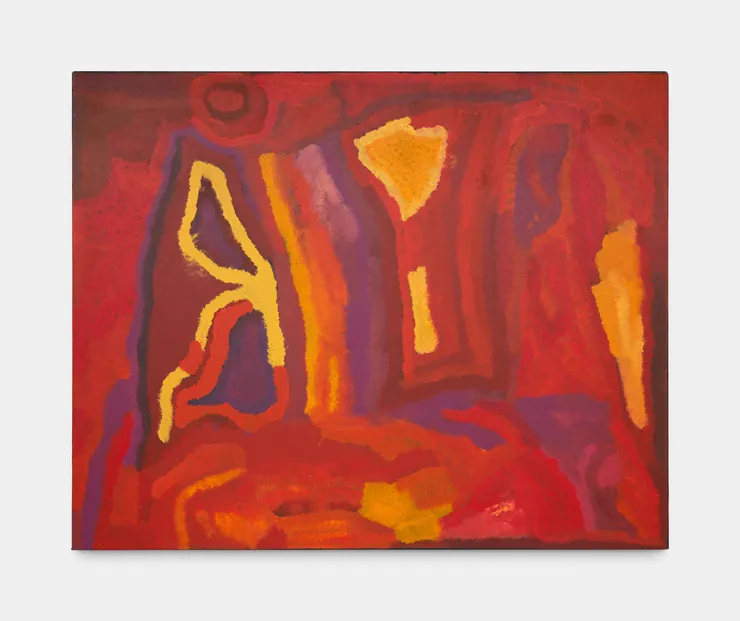
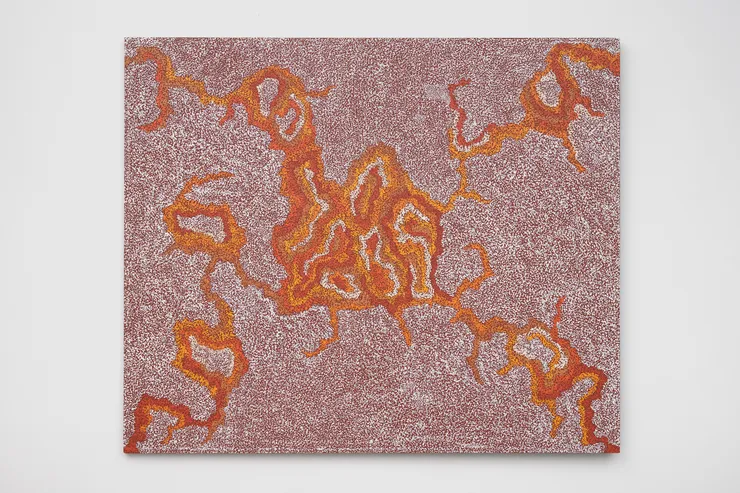
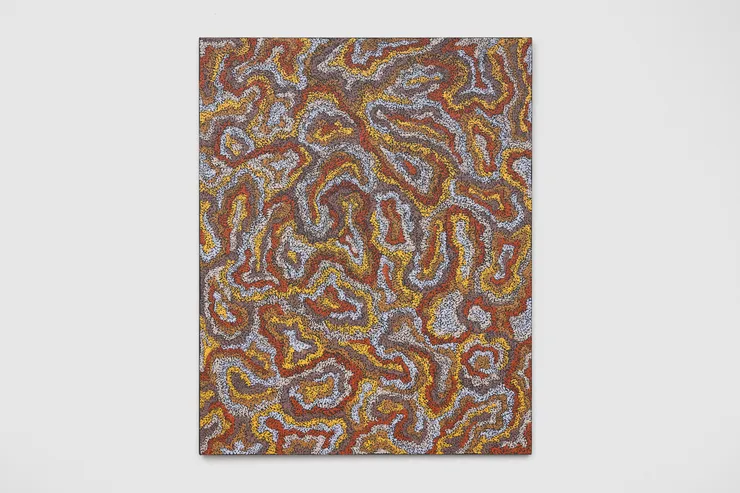
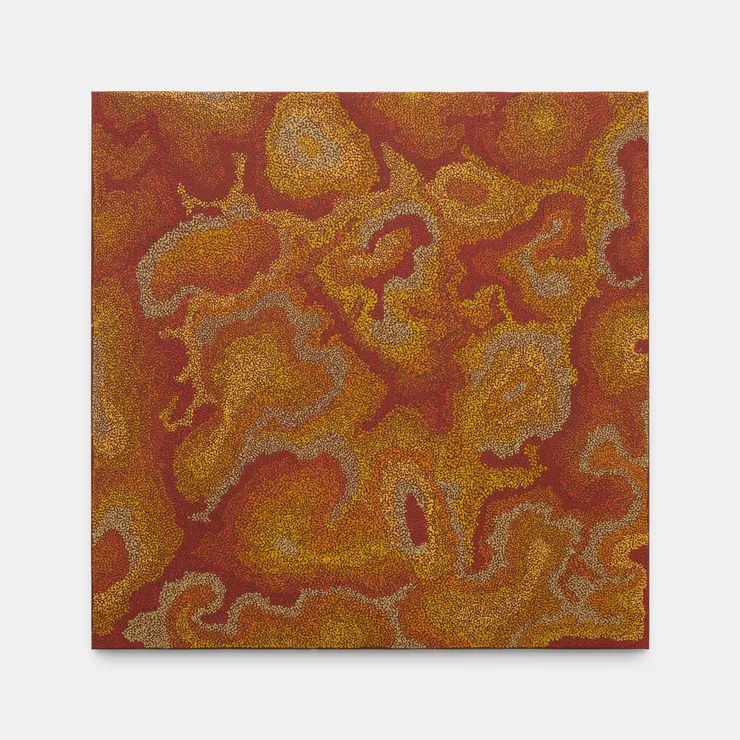
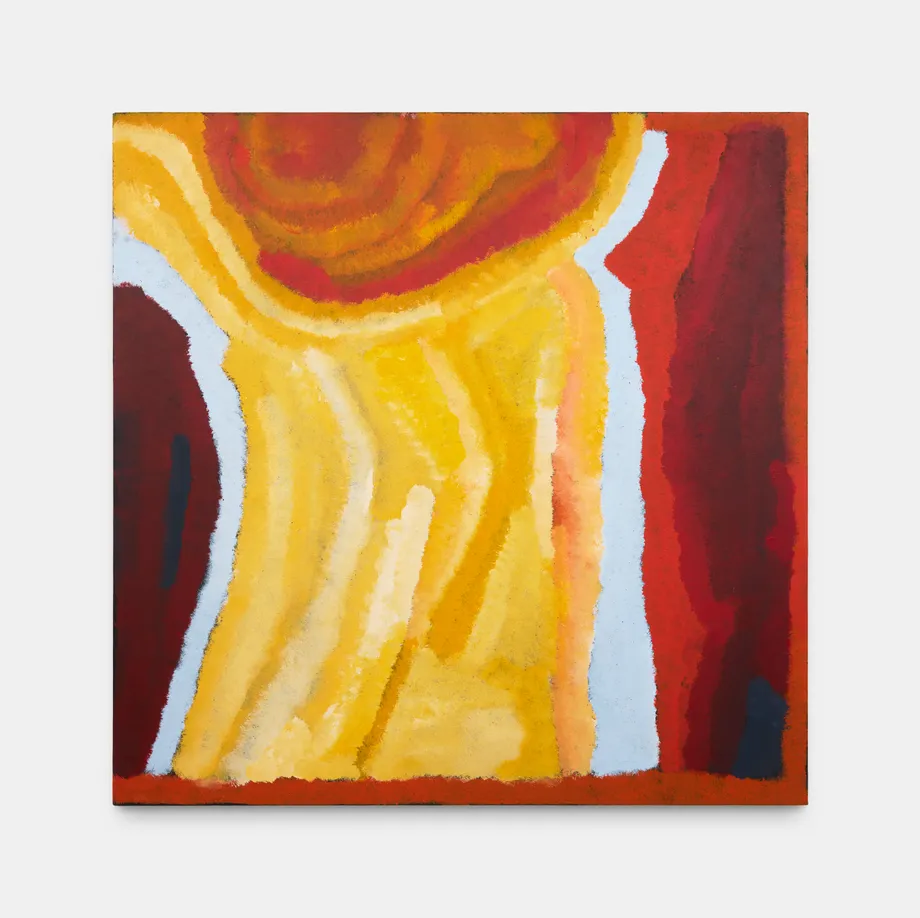
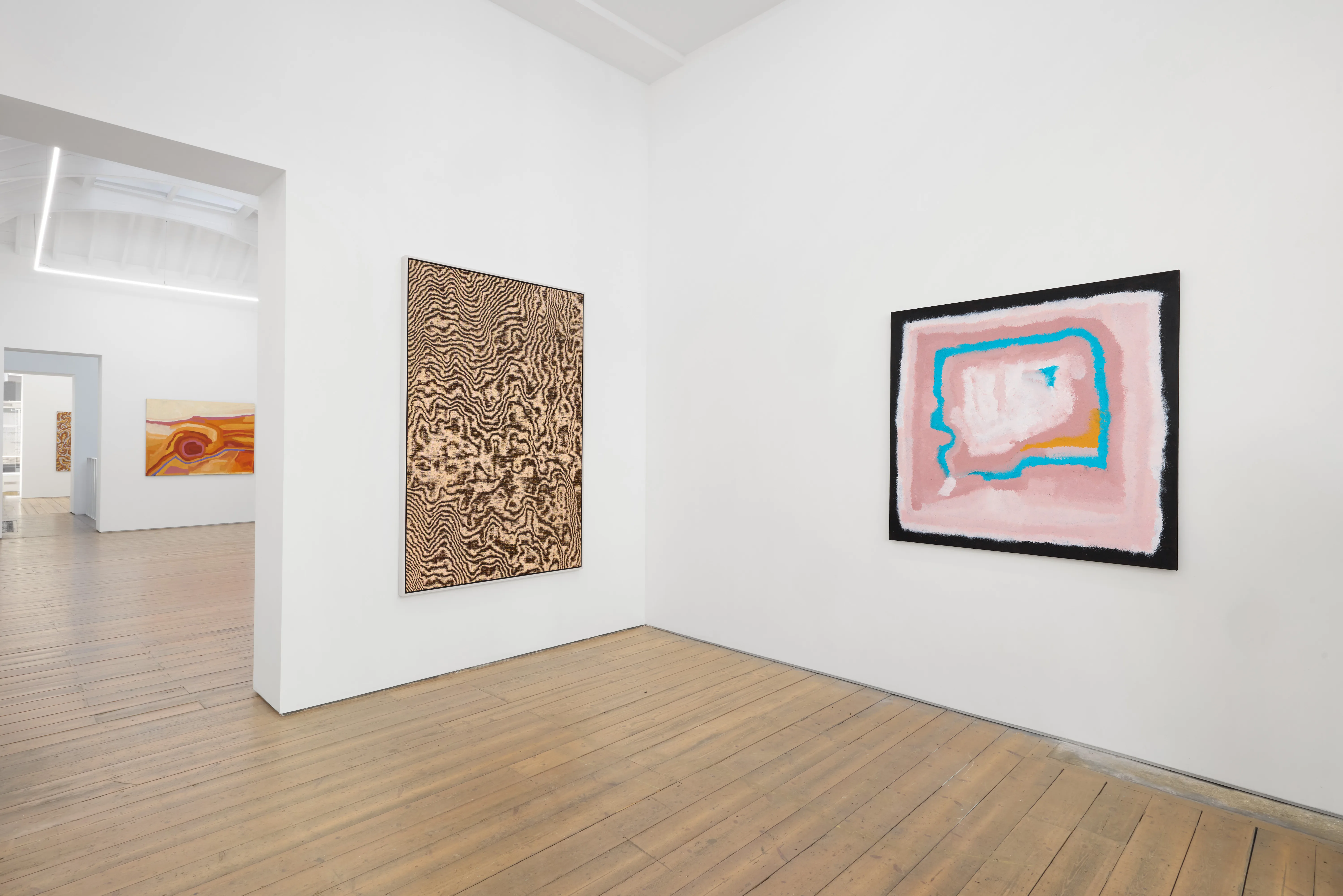
Edel Assanti is pleased to present a parallel presentation of work by Lorna Ward Napanangka, Yukultji Napangati, and John West Tjupurrula. All three artists are members of the Papunya Tula Artists cooperative in Papunya, Australia, which is entirely owned and directed by traditional Aboriginal people from the Western Desert, predominantly of the Luritja/Pintupi language groups, pioneering the use of manmade pigment and hard surface to depict traditional body and sand painting associated with ceremony.
The paintings in this exhibition use abstraction as a strategy to conceal protected knowledge, depicting sacred landscapes and associated narratives through repetition and careful obfuscation. In Aboriginal and Torres Strait Islander oral cultures – like the Pintupi – the land is understood as a living, communicative presence, within which knowledge essential for survival can be gleaned through attentive engagement with earth, animals, and place. Dreamings, or Tjukurrpa, are a way of describing one’s relationship to human and non-human parts of a landscape, and function as an auditory mnemonic, or memory-aid, of safe routes through arid Country. Dreamings are differentiated between sex, and are inherited via a logical system of birthplace, tribal or language group, and authority within the community.
Works by Lorna Ward Napanangka and Yukultji Napangati are presented across two of the gallery’s rooms, drawing attention to the formal contrasts and similarities in the two women’s practices, and honouring the proximity of their ancestral homelands around Wilkinkara (Lake Mackay). Napanangka was born in the early 1960s, and is the daughter of the significant first generation Papunya Tula artist Timmy Payungka Tjapangardi. She inherited important ancestral knowledge from her father, the main custodian for a significant ceremonial site known as Parrayingi. Her compositions vary between works and combine subtle layers of line and dot work to meticulously place colour and form. Reds, ochers and dusty oranges of the Gibson Desert are shot through with sudden ribbons of blue or yellow, hinting at the significance of waterways and safe passage through Country. Ward Napanangka portrays Tingari stories from her ancestral Country around Lake Mackay; her works express her deep knowledge of, and connection to, traditional ancestral laws, and her particular standing and authority within her community.
Yukultji Napangati was born at Marrapinti, a sacred women’s ceremonial site, and spent her early life living semi-nomadically in the bush. In 1984, at the age of fourteen, she and her family were reunited with Pintupi kin at the newly established community of Kiwirrkura after being sighted by settler Australians. Drawing on Dreamings associated with Marrapinti – her mother’s Country – her dense networks of lines and dots evoke the windswept sand dunes of her Gibson Desert homelands near Lake Mackay. Using stippling and dotting organised into undulating lines, subtle gradations and shifts in colour suggest the optical effect of shimmering heat and light on sand.
Exhibited in the adjacent gallery, the work of John West Tjupurrula (b. 1982, based in Kiwirrkurra, Australia) is informed by his position as the son of two recognised artists who worked through Papunya Tula Artists, Freddy West Tjakamarra and Payu Napaltjarri, as well as his work as a ranger, using drones to survey unimaginably vast expanses of Country. Of a younger generation than Napangati and Ward Napanangka, in his work, Country is painted with simultaneous perspectives, as seen from above and as experienced by traveling on foot, as the Pintupi would have. Sinuous, interconnected forms and clusters of marks represent songlines, or journeys, taken by Ancestors in the Dreamtime; sudden changes in colour and certain repeating forms hover on the surface of the images, at once too distant and too close to discern.
David Abram writes, “Language here is inseparable from song and story, and the songs and stories, in turn, are inseparable from the shapes and features of the land.” As one traverses Country, one is continually reminded of its associated Dreamings; this self-perpetuating loop, or spiral, is evoked through the abstract repetitions of painted marks, their characteristic ‘shimmer’. The seemingly rhythmic distillation of these compositions belies their complexity and their potential to be unlocked or used by the appropriate person. Both map and territory, the works in this exhibition operate in a time so deep it is almost a fourth dimension, opaque portals into a radically interconnected understanding of human life and the natural world.
This exhibition is accompanied by a text by Tamsin Hong, Exhibitions Curator at Serpentine.


-
 Lorna Ward Napanangka, Marrapinti, 2025
 -
Lorna Ward Napanangka, Marrapinti, 2025
-
Lorna Ward Napanangka, Marrapinti, 2025
-
Lorna Ward Napanangka, Marrapinti, 2025
-
Yukultji Napangati, Ancestral Women at Yunala, 2006
-
Yukultji Napangati, Untitled, 2024
-
Yukultji Napangati, Untitled, 2024
-
Yukultji Napangati, Women’s Ceremonies at Marrapinti, 2015
-
John West Tjupurrula, Palipalintja, 2025
-
John West Tjupurrula, Palipalintja, 2025
-
John West Tjupurrula, Palipalintja, 2025