An evocative new Tate Britain show captures an era when the UK's newly flush creative industries teamed up with a generation of skint dreamers to bring the decade into vivid colour
Here is Kate Moss, with pink hair splayed across a pillow, her face scrubbed of makeup, her smile sweet and wonky. Sarah Lucas's Pauline Bunny artwork with its confrontational hosiery on a charity shop chair. Sean Ellis's collaborative knights-in-grubby-armour shoot with Alexander McQueen. Here are happy ravers, in a club, or saluting the sun as it stretches and yawns over a litter-strewn hill.
These photos are old. They were taken a long time ago. But they're young, too. They are curated by Edward Enninful for the Tate's exhibition The 90s: Art and Fashion (Enninful worked at i-D in the 90s) and almost everyone involved is shiny and fresh. The models, whether professional or not, are mostly in their 20s, and the photographers are early in their careers. It gives the photos a youthful fizz, a verve. But the energy also comes from an understanding between photographer and subject. In many of the pictures you can feel the shared mischief, a "yes we're serious about our ideas" but also a "look, we're getting away with it!" delight.
At the time these photos were taken I was writing for magazines such as Select, the Face and Smash Hits. I know some of the subjects in the pictures, as well as some of the photographers. No surprise: I was out a lot, and so were a lot of people in what we now call the creative industries. We were excited: we had just moved to London, or Manchester, had recently left art college or school or university, managed to wangle our ways into occasional, seemingly glamorous jobs that hadn't yet blossomed into careers. As every generation must, we were elbowing our way in from the edges to the mainstream, finding space for ourselves and people like us. Some of the people in these pictures eventually became very rich, and so moved into different circles. But at the time, everyone was on a level. Skint, hard-working and up for a good night out.
Parties were plentiful. Aside from the club scene, magazines threw them, art galleries threw them, some random person that you met in a late-night drinking den said, "I know this place", so you went. When you were out, you met artists, photographers, musicians, actors, writers, promoters, dealers, "entrepreneurs". Often you had no idea what they did: I once walked into an office and realised that the esteemed head of design was the character with whom I'd spent a full-on all-nighter at Glastonbury a month before.
Such times were documented, of course, or these images would not exist. But in everyday life, we were less visually obsessed. When you went on a night out, one of your friends might have a camera with them, but they'd forget to use it or leave it in a pile of coats in a darkened corner, never to be seen again. You would embark on whatever adventure the evening might bring and afterwards there wouldn't be much evidence of it; the sweat and grime washed off by a barely functioning shower. No wonder the good photographers capturing this era had a specialness, a status.
Now the 90s are far enough away for us to understand them, it's clear that there was a hidden architecture to those times, one that supported this burst of creativity. It wasn't just the party venues that were easy to find. The flats were horrible, but they were plentiful and central, and rent was cheap. I never paid more than £60 a week for a room in a flatshare. And if you couldn't afford that, you could squat, or claim housing benefit until someone official caught on that you were working, too. So we had places to live, but there was no internet to keep us there: if we wanted food or drink or sex, we couldn't magic them up on our phones. To get those, you had to leave the house, and we did, often not returning for days at a time. Some friends of mine had what they called "going home fear". They'd only return to their flat for an hour, to wash and get changed before going straight back out again.
Another factor that propped up that time was that the music industry was flush with money from the invention of CDs. Such riches meant that major labels could afford to fund indie labels, indie labels could pay independent PRs to promote their bands, and music magazines could pay journalists to write about them. There were enough jobs in that industry, and in fashion and photography and art, for the people in power to take a punt on the enthusiastic newbie, someone who'd come from nowhere, who knew no one but who had interesting ideas and who kept on coming back. A whole generation of cocky, idea-fuelled kids trying their hands at modelling, writing, presenting, art. Or photography.
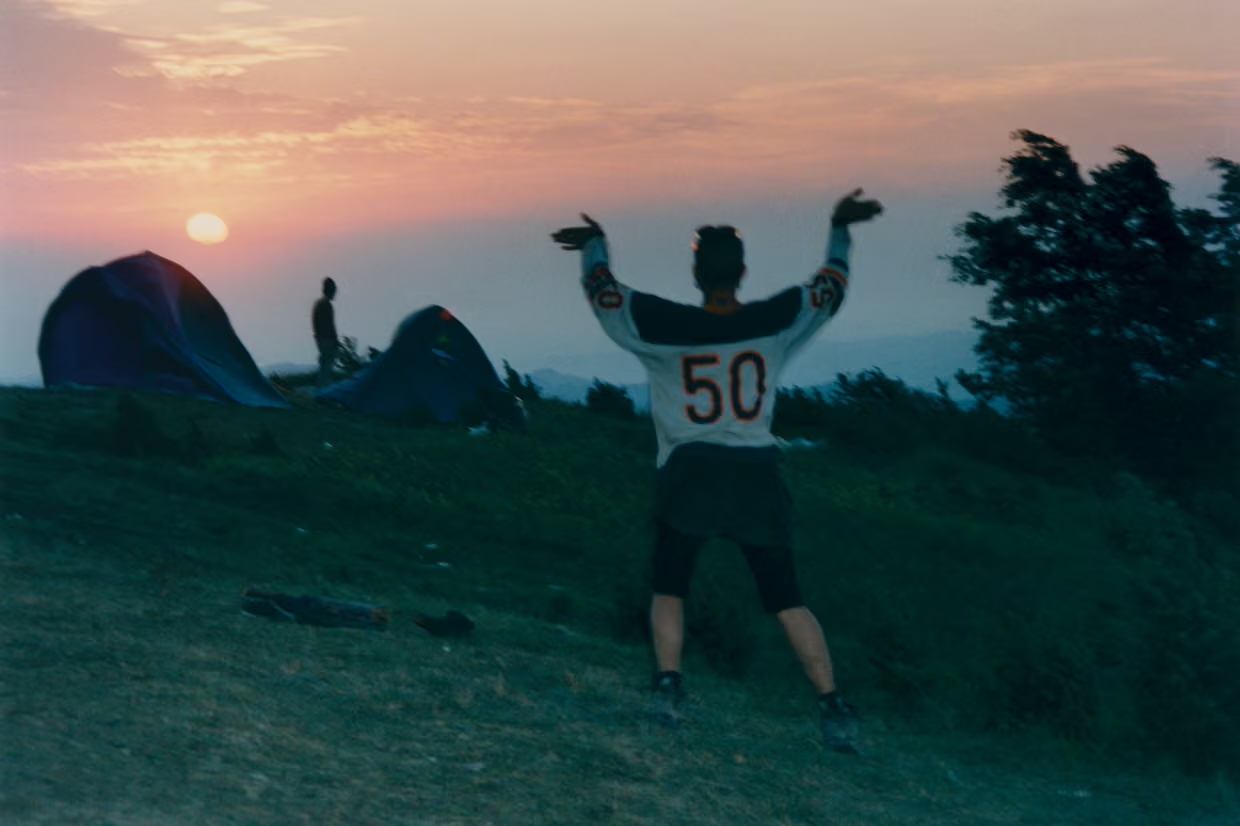
Paula Sunrise by Vinca Petersen, 1997
Petersen: “After the 1994 Criminal Justice Act outlawed raves in the UK, I spent a decade travelling around Europe in a van trying to recreate that way of living. This shot captures that feeling of having spent the whole night dancing in the dark in a huge crowd. There is something special about that moment when the sun slowly appears and you start to see the faces of all the people you’ve been surrounded by, and inevitably often sit down and end up talking about the big stuff in life. Nowadays I do kitchen discos. But that sense of freedom and creativity has stayed with us all. The last time I spoke to Paula she was working in the Houses of Parliament.”